Deer hut
BackIn the heart of the Idrija-Cerkljansko hills, in the Idrijske Krnice area, there once stood the Jelenk Hut, which today remains only a memory in the hearts of many hikers, hunters and nature lovers. Although its doors are closed forever, the story of this outpost tells of the times when it represented an important point for rest, socializing and enjoying authentic local food . It was located in a strategic location, which served as a starting point or intermediate station for the climb to the 1107-meter-high Jelenk peak, which reigns between the Idrijca and Kanomljica valleys. This location was not just a geographical point, but a symbol of the junction between the Alpine and Dinaric worlds, an area intertwined with rich flora and fauna, where hikers could rest before continuing their journey.
Historical significance and role in the community
The Jelenk Lodge was not just an ordinary inn ; it was closely connected to the local hunting community. Its history is intertwined with the Jelenk Hunting Association Spodnja Idrija, which was established as a result of the post-war reorganization of hunting associations. The decision to build a hunting lodge under the Jelenk was made in 1958, and it was built with the hard work and volunteer work of its members, and dedicated to its purpose in 1960. This is a testament to the strong connection and community spirit that prevailed in this area. The lodge served as a center of events for hunters, a place for meetings, education and socializing after the hunt. In 1983, a thorough renovation began, which was completed two years later, which shows its importance and the desire to preserve and improve it. Over time, it became much more than just a hunting lodge; it also opened its doors to the general public and became a popular excursion spot for everyone who visited these parts.
Culinary offer: Tastes of tradition
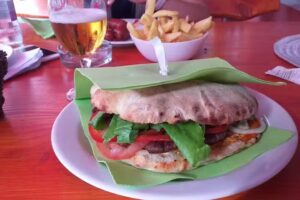
Although it is not easy to obtain precise menus from the archives, it is possible to conclude with great certainty what the cuisine was like at Koča Jelenk. As is typical for mountain huts in Slovenia, the menu focused on simple, yet hearty and tasty dishes that restored energy to hikers. The menu certainly included classic dishes such as jota, ričet and goulash. Meat dishes, especially venison, also had a special place, which is entirely expected given the hunting nature of the hut. Visitors could enjoy dishes prepared from locally sourced ingredients, which ensured authenticity and freshness. Of course, we must not forget the Idrija culinary specialty – Idrija žlikrofi. Although Koča Jelenk may have had its own version, this dish is the trademark of the entire region. In addition to žlikrofi, other local specialties were also available, such as ocvirkovca and štruklji, which rounded out the range of traditional Slovenian cuisine .
Advantages and positive aspects of Koča Jelenk
The Jelenk Hut had many qualities that made it so popular with visitors. Let's take a look at some of the key advantages that characterized it during its operation.
Exceptional location and natural environment
The hut's greatest advantage was undoubtedly its location. Set in the unspoiled nature of Idrijske Krnice, it offered visitors an escape from the hustle and bustle of everyday life. Peace, fresh air and stunning views of the surrounding peaks, including the Julian Alps in good weather, created a unique experience. The proximity of numerous hiking trails, including the Idrijsko-Cerkljanska mountain trail and the Slovene mountain trail, made the hut one of the key stops for hikers. It was a place where mountain lovers met, exchanged experiences and planned new adventures.
Authentic and homely atmosphere
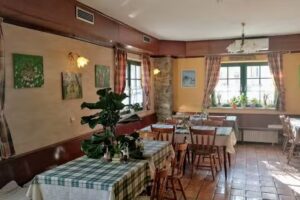
Unlike many modern restaurants , Koča Jelenk maintained its rustic and homely charm. Visitors appreciated the simplicity and warmth that greeted them upon arrival. Whether it was a group of hikers, a family on a Sunday outing, or hunters after a hard day, the hut offered shelter and a sense of belonging. This authentic atmosphere was key to its popularity, as people returned not only for the food, but also for the sense of homeliness that is often lacking in city restaurants .
Culinary reliability
The catering offer was based on proven recipes and quality ingredients. The homemade food that was served was always a reliable choice. Visitors knew that they would get a generous portion of tasty and filling food that would not disappoint them. This reliability was an important factor, because after several hours of walking, hikers could rely on the fact that a hearty meal would be waiting for them in the hut to restore their strength. The emphasis on game dishes set the hut apart from others and gave it a recognizable culinary mark.
Weaknesses and challenges faced
Despite its many positive attributes, operating such a facility also comes with challenges. While we can only speculate today about the exact reasons for the permanent closure, we can analyze some of the potential weaknesses and issues that may have contributed to this decision.
Accessibility and distance
Its location, which was its greatest advantage, was also a hindrance. The Jelenk Hut was not a restaurant that you could drive into casually. Access to it required driving along narrow, ascending roads, and part of the route was macadam. In winter, accessibility was even more difficult and dependent on weather conditions. This relative remoteness limited the circle of potential guests to those who were willing to make the extra effort to visit. Unlike the inns in the valley, it depended primarily on hikers and excursionists, which meant a greater seasonality of business.
Infrastructure limitations
Managing a mountain hut is logistically demanding. Providing food, energy and water in remote locations is more expensive and complex. Maintaining a facility in a mountainous environment, where weather influences are more pronounced, also requires constant investment. It is possible that the costs of updating and maintenance have become too great a burden over time. Modern guests have increasingly high expectations of comfort, which presents an additional challenge for older facilities such as Koča Jelenk to adapt.
Permanent closure as the biggest drawback
The biggest "weakness" of the Jelenk Hut today is, of course, the fact that it is no longer in operation. Its legacy lives on, but the physical absence of a functioning outpost represents a great loss for the local tourism and hiking community. The Jelenk area remains a popular hiking destination, but hikers no longer have the opportunity to stop, refresh, and shelter that the hut once offered. Many who knew it miss it, and new visitors are deprived of the experience that was once an integral part of visiting this part of Slovenia. The closure of the Jelenk Hut is a reminder of how precious such places are and how important it is to preserve them for future generations.