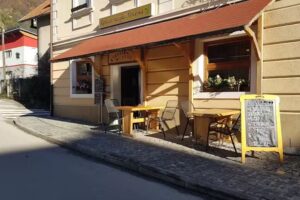

Cooperative home Čeče
BackThe Čeče Cooperative House, located at Čeče - part 100a in Hrastnik, is an example of a catering establishment whose story has come to an end. The fact that it is permanently closed is a key piece of information for anyone who might want to visit this place. Nevertheless, its past role and significance for the local community offer an insight into the workings and soul of traditional Slovenian village gathering places, which were once the heart of social life.
The establishment was not just one of many restaurants ; as the name suggests, it operated within a cooperative home. Historically, such homes throughout Slovenia were more than just places to eat. They were the centers of local communities, where cultural events, meetings, weddings and other celebrations took place. They often included a hall, a shop and, of course, a tavern , which served as a central place for socializing. The cooperative home in Čeče was opened in 1968 and represented an important part of local life.
What did the Čeče Cooperative Home represent?
Given its status and location, we can conclude that the Čeče Cooperative offered an authentic experience focused on traditional, home-cooked food . In such establishments, menus did not follow modern culinary trends, but relied on proven recipes that had been passed down from generation to generation. Zasavje, the region in which Hrastnik is located, is known for its mining past, which is also reflected in its cuisine. The food had to be strong, filling, and simple to give workers the energy for hard physical labor.
Although we have no concrete information about the menu, we can imagine that it was dominated by dishes typical of this part of Slovenia. These include various stews, such as bean soup, ajmoht (a type of stew), and perhaps even liver stew, which is considered a Zasavje specialty. A special place would certainly be given to "funšterc", also known as "knapovsko sonce", a simple egg dish that was once a key part of the miners' diet. On Sundays, such inns often became a destination for family lunches, where beef soup, roasted potatoes, and various types of roasted meat were on the table.
Advantages: Heart of the local community
The greatest value of the Zadružní dom Čeče was not necessarily in its superb culinary experience , but in its social role. For the residents of Čeče and the surrounding areas, it was a place where they met, exchanged news and strengthened their bonds. It represented certainty – a place where you could go for a drink after work, celebrate a personal holiday or simply chat with your neighbors. These are qualities that modern, more impersonal restaurants have a hard time replacing.
- Authenticity: The offering was probably focused on authentic Slovenian cuisine , without unnecessary embellishments, which many guests especially appreciate today.
- Accessibility: Prices in such establishments were generally more accessible to a wider range of people, which enabled regular visits.
- Sociability: It served as an indispensable social space that contributed to the vitality and cohesion of the village.
- Supporting the local environment: The operation of such an inn often involved cooperation with local suppliers, which strengthened the local economy.
Cons: Rural hospitality challenges and closure
The main and obvious weakness of the Čeče Cooperative is its permanent closure. This sad reality reflects the broader problems facing many rural inns in Slovenia. The reasons for the closure are often complex and interrelated. The long-term tenant, who ran the inn for almost twenty years until the end of 2019, cited the decline in traffic, difficulties in finding workers (cooks and waiters), and the long-term closure of the Hrastnik-Čeče road, which drastically reduced the number of guests, especially those who came for Sunday lunches. Even after the road was reopened, traffic could not be returned to its previous level.
The municipality of Hrastnik has tried several times to find a new tenant for the premises, but unfortunately without success, as no applications were received for the tenders. This points to structural problems: changing lifestyles, the emigration of young people from rural areas and competition from more modern catering providers are factors that threaten the existence of traditional village gathering places. For a potential guest looking for somewhere to have lunch , the end result is the same: one less option.
What does closure mean for the visitor?
For a visitor looking for restaurant reviews in the Hrastnik area today, Zadružni dom Čeče is no longer a relevant choice. Its story has become a reminder of the transience of life and the importance of supporting local restaurateurs. While larger cities offer a wide range of culinary options, in smaller towns, it is precisely such inns that preserve local identity and offer a unique insight into the soul of the place. Their disappearance means not only the loss of a place to eat, but also the loss of part of the cultural heritage.
The Čeče Cooperative House was undoubtedly an important part of the local pulse in its time. It represented a place where social life took place with good food and drink. Its offer was most likely based on simple but delicious traditional homemade food , which reflected the culinary heritage of Zasavje. Despite the positive aspects it brought to the community, it faced challenges that were too great for its continued operation. The fact that it is now permanently closed is its biggest drawback. Its story serves as an important reminder that traditional restaurants and taverns are a valuable part of our culture, which need the active support of guests and the wider community to exist.